What is Digital TestAS? Detailed Comparison Between Paper-based and Digital TestAS
Digital TestAS is the fully computer-based version of the standardized TestAS examination, administered at authorized testing centers worldwide. The most prominent differences between the two formats lie in the testing experience: Digital TestAS reduces total test time to approximately 3.5 hours, prohibits physical scratch paper, enforces strict one-way navigation (no returning to prior questions), and expands available subject modules to six instead of four.
If you are deciding whether to register for the paper-based or computer-based test, this detailed side-by-side comparison will help you and your family select the format best matched to your strengths.
1. What is Digital TestAS?
Digital TestAS evaluates the cognitive abilities and academic aptitude of international students applying to undergraduate programs in Germany, delivered entirely via secure exam software on computer workstations.
Just like the traditional paper version, Digital TestAS does not test rote memorization. It measures inductive and deductive reasoning, data analysis, and scientific problem-solving in either English or German.
Your TestAS score acts as an independent performance credential for APS verification, student visa applications, and direct university admission across Germany and German-standard universities in Vietnam, such as Vietnamese-German University (VGU).
For general exam structure, fees, and rules, check our foundation guide: What is TestAS? Exam Structure, Fees, and Registration Guide 2026.
2. Overview Comparison: Paper TestAS vs Digital TestAS
Here is a summary matrix outlining the fundamental differences between both testing formats:
| Criterion | Paper TestAS (Paper-Based) | Digital TestAS (Computer-Based) |
|---|---|---|
| Exam Interface | Printed exam booklets, filling bubble answer sheets with pencils. | Specialized computer software at authorized test centers. |
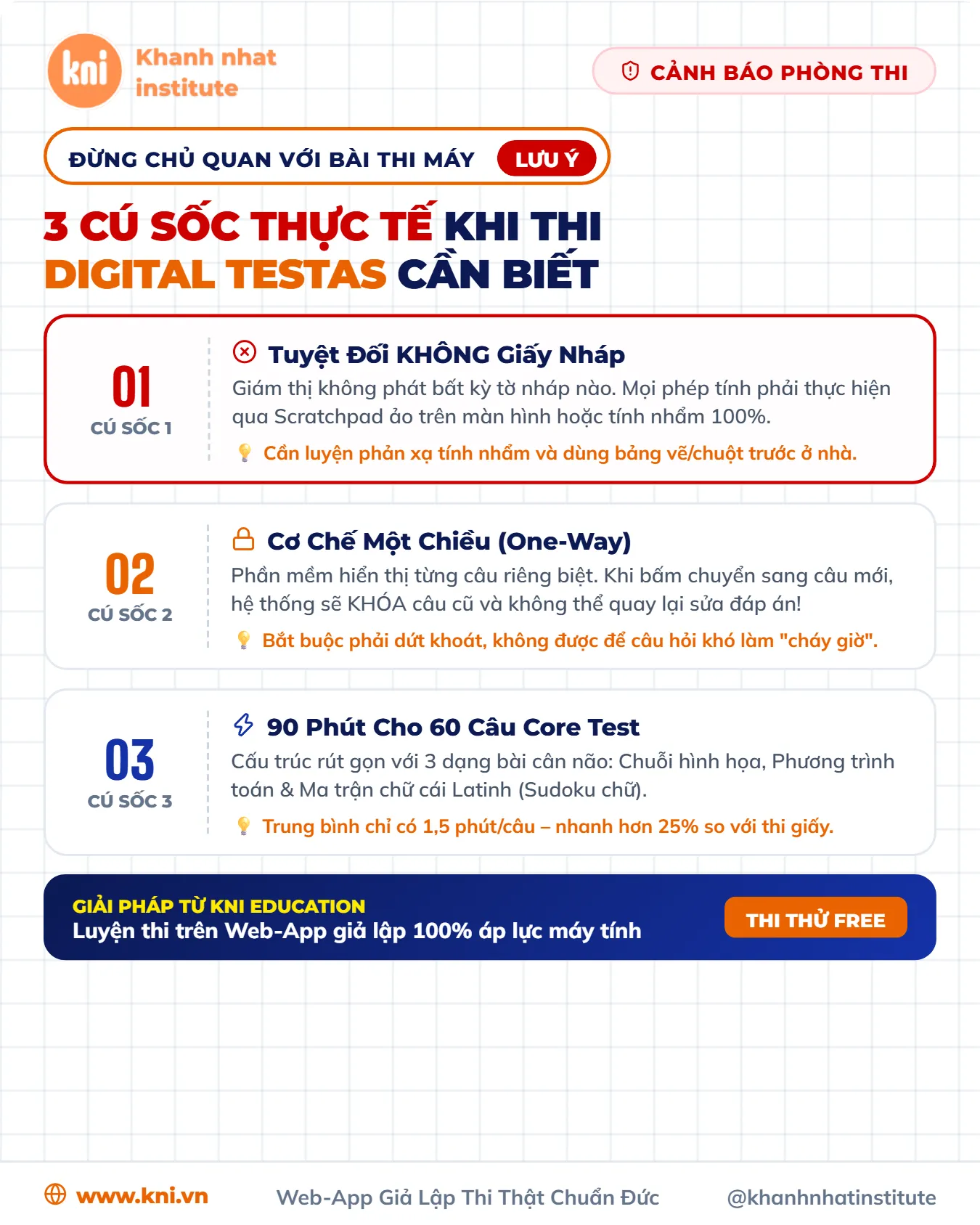
| Scratchpad Rules | Scratch paper provided; free to sketch, write, and underline directly in booklet. | Strictly no external scratch paper. Use on-screen digital scratchpad or mental math. |
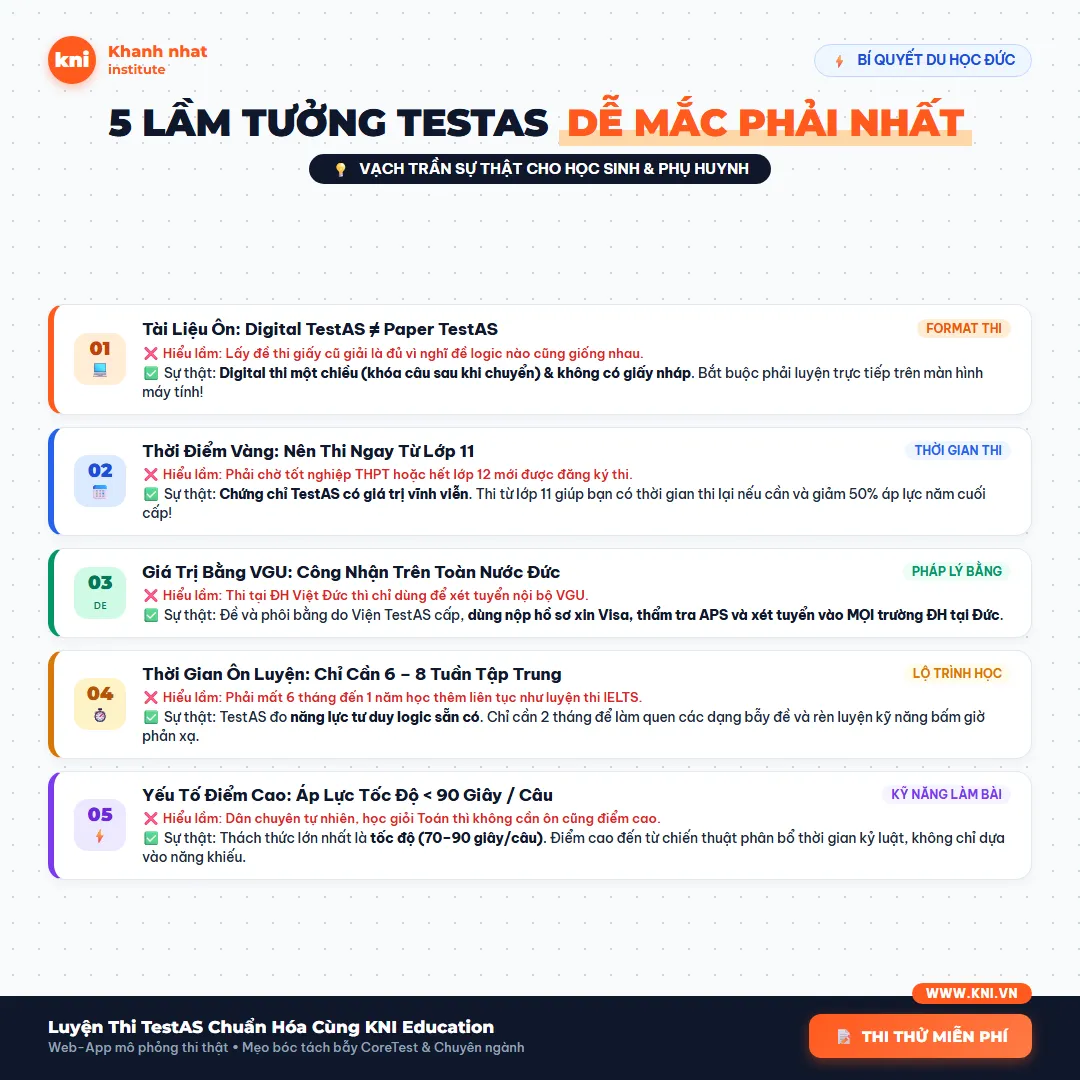
| Navigation | Free navigation: flip pages, preview questions, solve easier ones first. | One-way navigation: Cannot return to previous questions after confirming transition. |
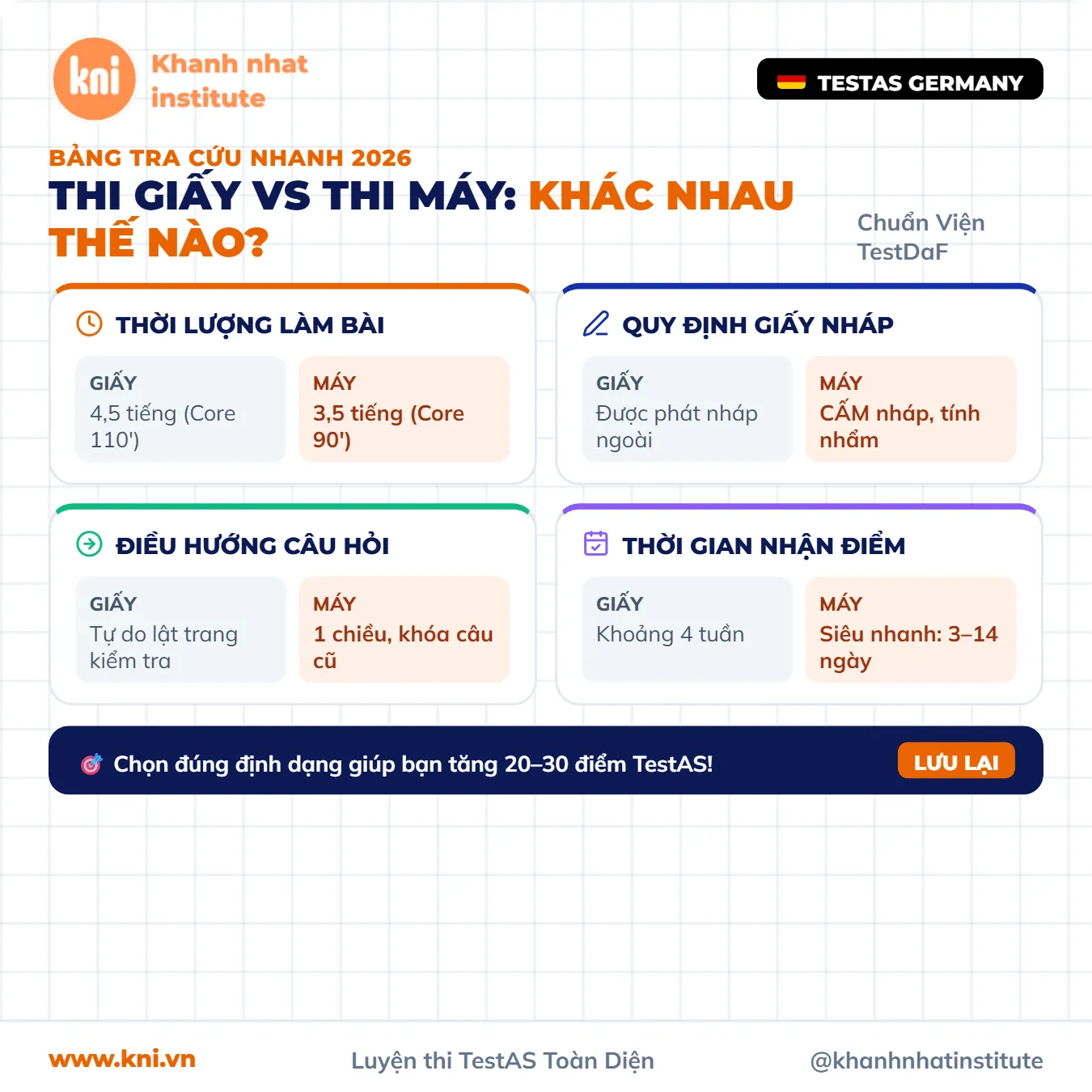
| Total Duration | Approximately 4.5 hours (including break). | Reduced to approximately 3.5 hours (including break). |
| Section Times | Core Test: 110 min.Subject Module: 145–150 min. | Core Module: 90 min.Subject Module: 90 min. |
| Subject Fields | 4 traditional fields. | 6 specialized fields (includes Medicine & Life Sciences). |
| Score Scale | Standard Score from 70 to 130. | TestAS score scale 0 to 200 (or extended scale 0–400). |
| Exam Frequency | 2–3 fixed dates per year (typically Feb, Apr, Oct). | More flexible with frequent test dates year-round. |
| Results Timeline | Around 4 weeks. | Significantly faster: several days to 2 weeks. |
3. 5 Core Differences to Understand Before Registering
3.1. Exam Structure and Timing
Digital TestAS reduces section duration considerably compared to the paper format:
- Core Module: Shortened from 110 minutes down to 90 minutes. The computer-based core test contains 60 questions divided evenly across 3 distinct subtests (20 questions each):
- Figure Sequences: Identifying geometric transformation patterns.
- Mathematical Equations: Rapid problem solving and determining unknown variables.
- Latin Squares: Sudoku-like letter matrices requiring unique letter distribution per row and column.
- Subject Module: Shortened from 145–150 minutes down to exactly 90 minutes.
3.2. Scratchpad Restrictions and Calculations
This represents the steepest technical hurdle for students in Engineering, Computer Science, and Economics:
- Paper Test: You receive blank paper, allowing long division, geometric sketching, and annotating prompts directly.
- Digital Test: Invigilators prohibit all physical scratch paper. All rough calculations must occur via an on-screen digital scratchpad tool using a mouse, or through disciplined mental calculation. Unfamiliarity with digital sketching drastically slows problem-solving velocity.
3.3. Navigation Logic: Free vs. Strictly One-Way
- Paper Test (Free): You can skim through the booklet, secure quick points on straightforward questions, and circle back to tough problems later.
- Digital Test (One-Way): Questions appear individually. Once you click "Next", the previous question is permanently locked and cannot be reviewed or modified. Every question demands decisive commitment.
3.4. Number of Subject Modules (4 vs 6 Fields)
Digital TestAS divides fields into 6 specialized modules, aligning closer with modern degree tracks:
- Humanities and Social Sciences
- Engineering
- Economics
- Mathematics, Computer Science and Natural Sciences
- Medicine (Exclusive to Digital TestAS)
- Life Sciences (Exclusive to Digital TestAS)
3.5. Scoring Scales and Result Delivery
- Scoring Scales: Paper tests display standard scores between 70 and 130 (with 100 being the global average). Digital results present scores on a scale from 0 to 200 (or 0–400 depending on the cohort scale). Both report percentile ranks enabling university comparisons.
- Grading Velocity: Automated computer grading returns digital test results in just a few days to 2 weeks, compared to 4 weeks for physical paper booklets shipped to Germany for centralized scoring.
4. Pros and Cons of Digital TestAS
Advantages:
- Rapid Score Release: Crucial for tight application deadlines with APS, Uni-assist, or scholarship committees.
- More Test Dates: Greater scheduling flexibility throughout the year.
- Targeted Modules: Essential for candidates pursuing German medical or life science degrees.
Disadvantages:
- One-Way Anxiety: Inability to backtrack increases psychological tension when encountering consecutive difficult items.
- Scratchpad Inconvenience: Digital mouse-sketching and on-screen note-taking feels unnatural and costs seconds per item.
- Screen Fatigue: Sustained on-screen concentration for over 3 hours tests physical stamina.
5. Which Format Should You Choose?
Choose Paper TestAS if:
- You are applying for Engineering or Mathematics where physical paper calculations and geometric sketches enhance reasoning clarity.
- You rely on tactical test-taking: skimming the whole section, answering easy questions first, and saving difficult ones for last.
- You started your preparations early and have ample runway before admission deadlines.
Choose Digital TestAS if:
- You are pursuing Medicine or Life Sciences (these fields are only offered digitally).
- You face impending deadlines for APS certification, scholarships, or university admissions.
- You possess fast reflexes, comfortable computer ergonomics, and solid mental calculation habits.
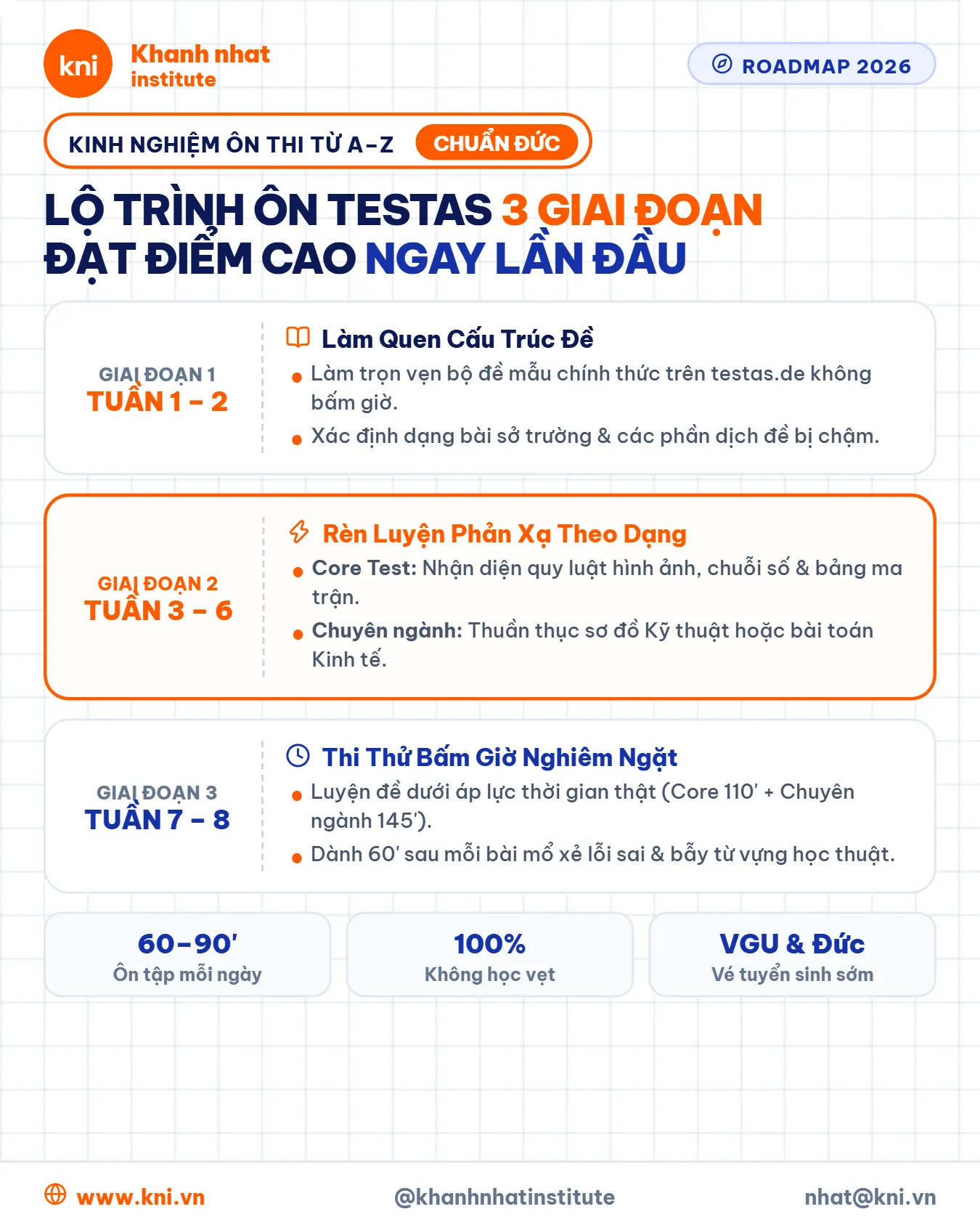
Further reading: Explore our TestAS Preparation Guide from A–Z to master time management strategies for both formats.
6. Frequently Asked Questions (FAQ)
1. Is Digital TestAS recognized the same as Paper TestAS?
Yes, absolutely. Both formats are issued by the TestDaF Institute, carry identical international validity, and never expire. German universities and VGU accept both without preference.
2. Can I bring a personal calculator into the Digital TestAS room?
No. Personal calculators are strictly forbidden for both formats. For Digital TestAS, an integrated on-screen basic calculator is provided automatically during sections where calculations are permitted.
3. Can I switch test languages during the exam?
No. You must choose your testing language (English or German) during registration on testas.de. The test software will only present the exam in the language selected beforehand.
Conclusion
Whether on paper or computer, TestAS remains a standardized benchmark of logical deduction and academic agility. Identifying the differences helps you choose the optimal format, tailor your preparation methods, and secure the highest possible score.
Professional TestAS Training at KNI Education
Whether you need to master digital exam interfaces, train speed on Latin Squares and Figure Sequences, or select the best module for your degree, KNI Education provides end-to-end guidance.
👉 Register for personalized roadmap consultation or take our free simulated TestAS mock test today.