Selecting the wrong Subject-Specific Module in the TestAS examination is a critical error that can invalidate your university application at the preliminary screening stage. TestAS is not a one-size-fits-all test: in addition to the compulsory Core Test, you must register for the precise academic field corresponding to your prospective degree program in Germany or at Vietnamese-German University (VGU).
This guide delivers an in-depth breakdown of each subject module, provides a comprehensive cognitive matrix, and features an exact major lookup table so you can choose correctly from day one.
1. Overview: What Subject Modules Does TestAS Offer?
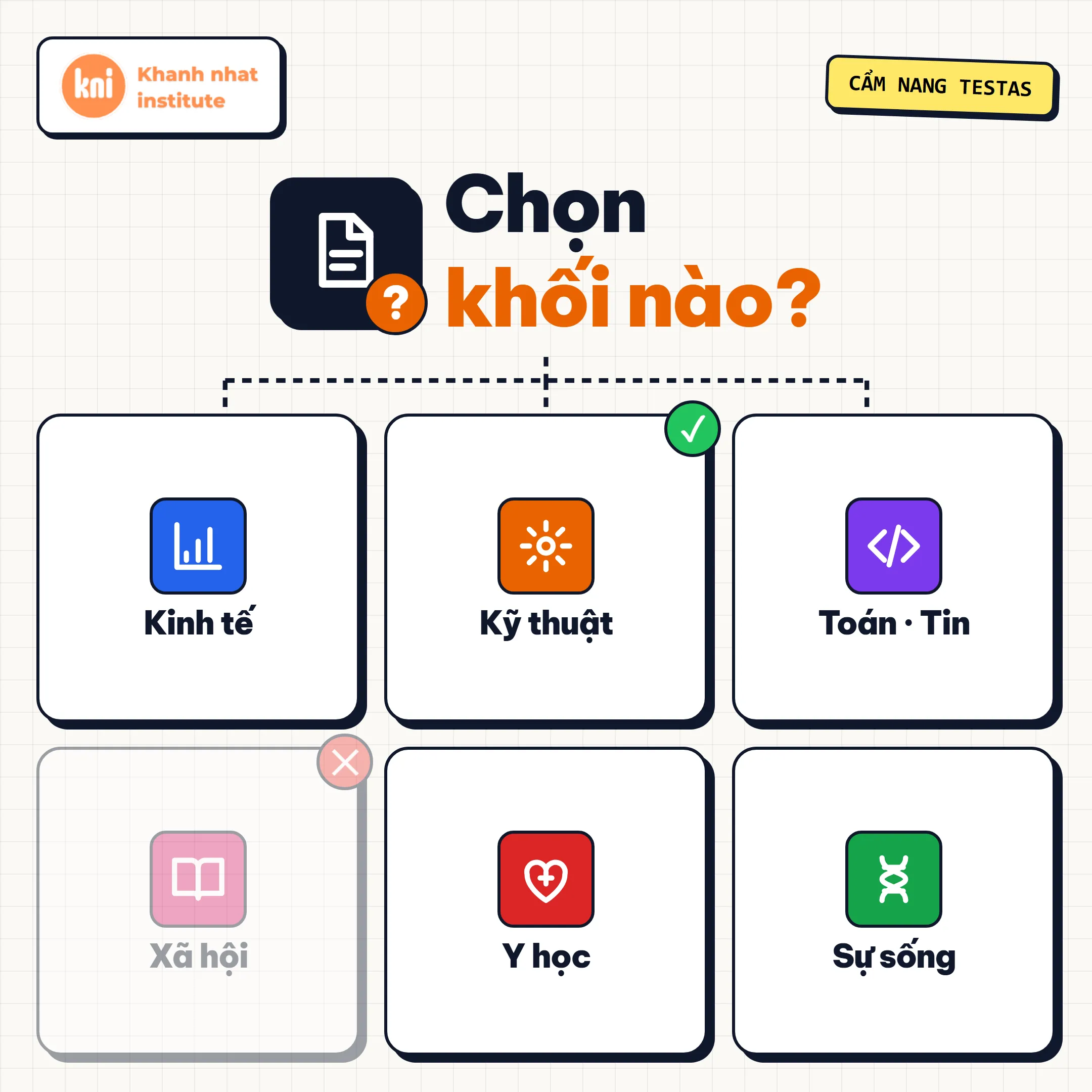
Every TestAS sitting contains two distinct parts: the Core Test measuring general analytical reasoning, and the Subject-Specific Module evaluating cognitive aptitude in your chosen academic discipline.
The number of available subject modules depends on the testing format you select:
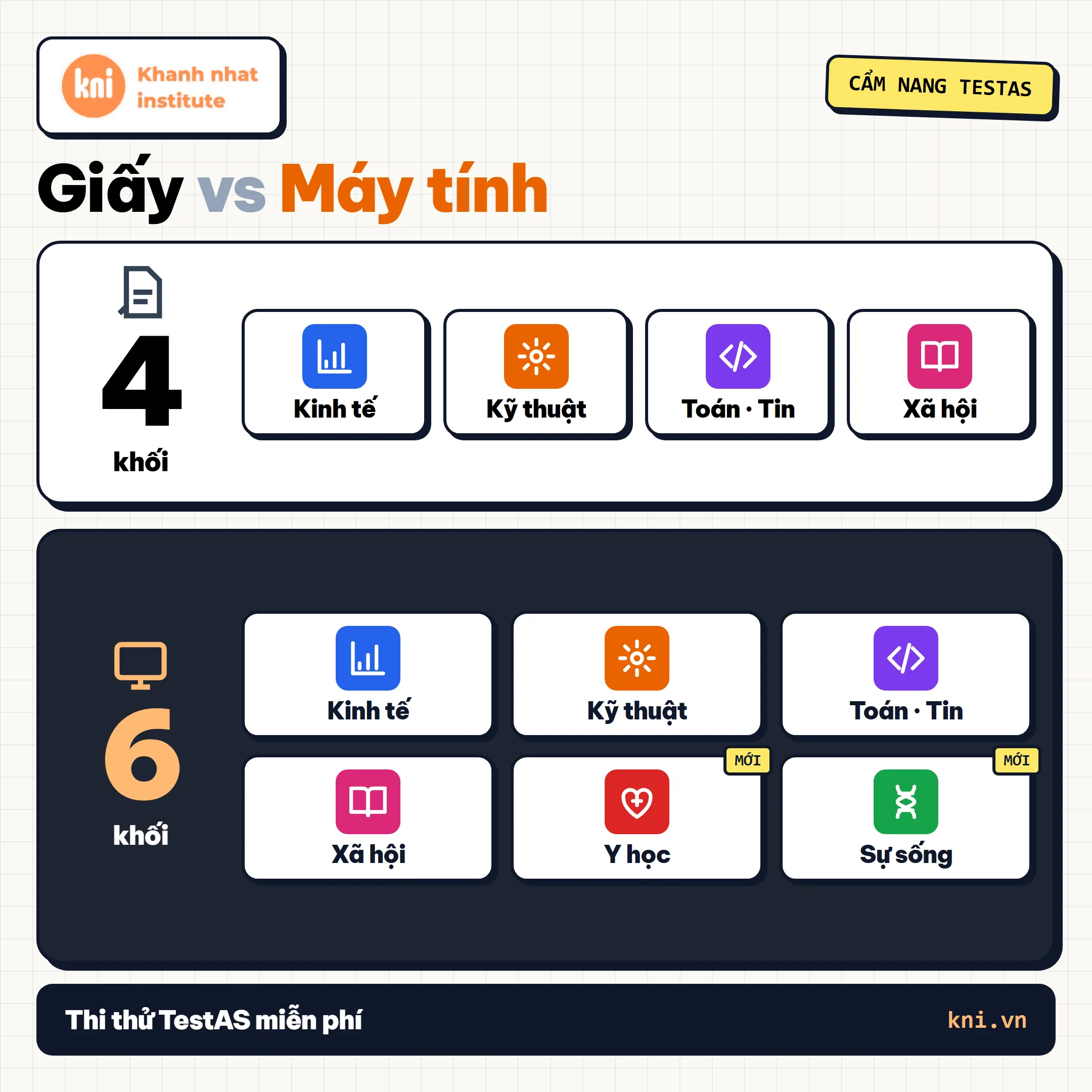
- Paper-based TestAS (Written): Offers 4 traditional modules: Economics; Engineering; Mathematics, Computer Science & Natural Sciences; and Humanities & Social Sciences.
- Digital TestAS (Computer-based): Features 6 specialized modules, introducing dedicated tracks for Medicine and Life Sciences.
Read our detailed format comparison: Digital TestAS vs. Paper TestAS: Detailed Format Comparison.
2. Cognitive Skill Matrix Across Subject Modules
Each specialized module assesses a unique dimension of reasoning. The comparative matrix below helps you evaluate how your personal cognitive strengths align with each examination:
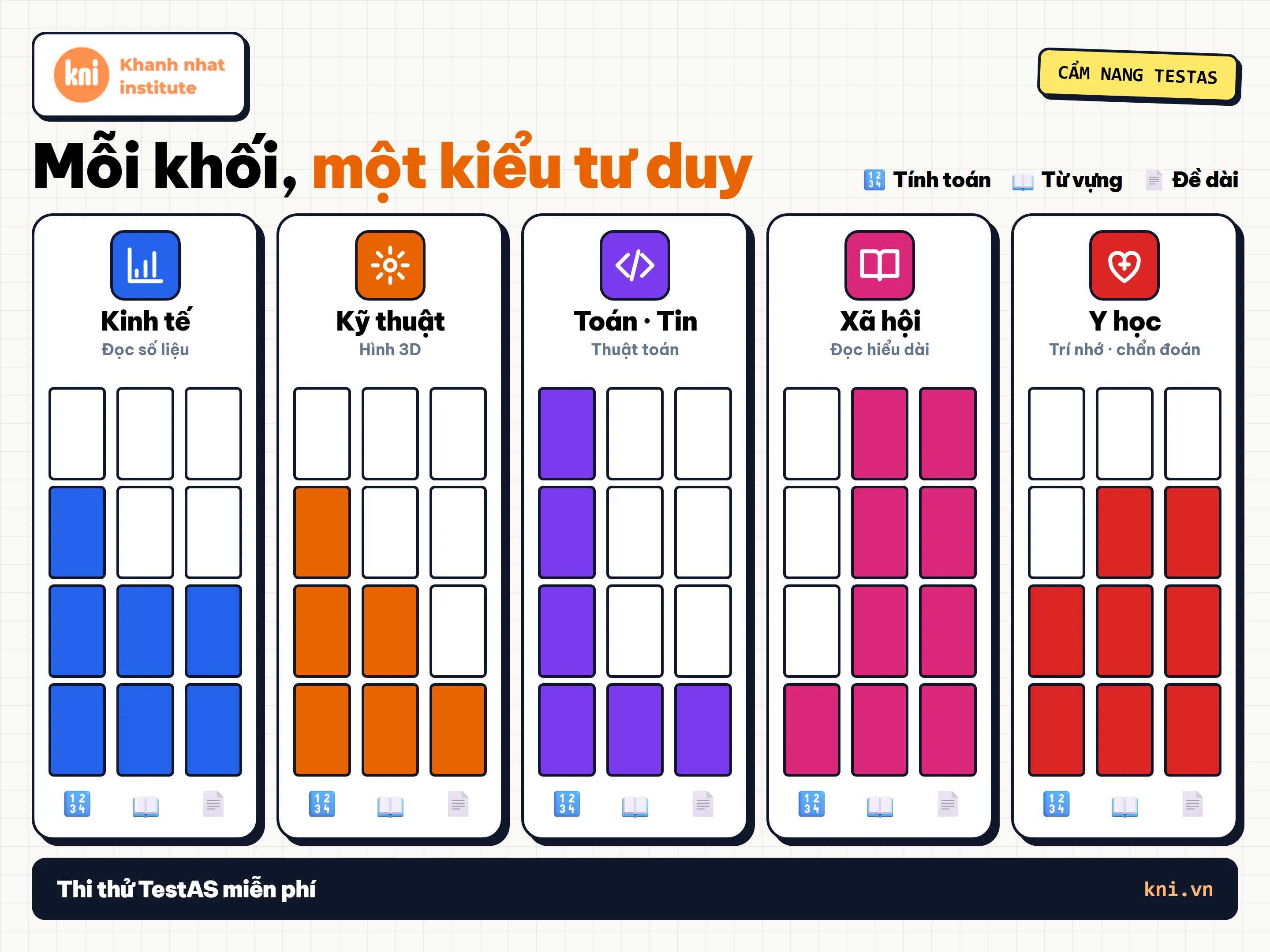
| Criteria | Economics | Engineering | Math, CS & Natural Sciences | Humanities & Social Sciences | Medicine & Life Sciences* |
|---|---|---|---|---|---|
| Cognitive Focus | Economic relationships, resource optimization, financial table analysis. | 3D spatial visualization, physical intuition, mechanical diagrams. | Pure algorithmic logic, mathematical deduction, coordinate graph analysis. | Extended academic reading, critical reasoning, contextual inference. | Rapid short-term retention, clinical diagnostics, biochemical chain deduction. |
| Quantitative Rigor | High: Percentage calculations, rule of three, cost-efficiency optimization. | Moderate – High: Algebraic formula transformation and applied physics. | Very High: Advanced numerical puzzles, function series patterns. | Low: Minimal arithmetic; heavily focused on verbal logic. | Moderate: Concentration ratios, genetics probabilities, biostatistics. |
| Vocabulary Demands | Moderate (Accounting, revenue, growth, macroeconomics). | Moderate (Mechanics, materials, component engineering). | Low – Moderate (Universal mathematical notations and symbols). | Very High: Abstract philosophical, historical, and sociopolitical terminology. | High: Biomedical nomenclature, anatomical structures, chemical compounds. |
| Reading Length | Short – Moderate (Accompanied by data tables and flowcharts). | Short (Predominantly blueprints, mechanical schematics, diagrams). | Very Short (Dense equations, symbols, and problem prompts). | Extensive: Academic essays spanning 1 to 2 pages per passage. | Moderate – Long (Clinical cases and experimental protocols). |
* Medicine and Life Sciences modules are exclusive to the Digital TestAS format.
3. In-Depth Breakdown of Each Subject Module
3.1. Economics Module
This module measures quantitative reasoning, supply-and-demand modeling, and optimal decision-making under constrained business scenarios.
- Paper Format Structure (2 subtests – 44 questions / 145 minutes):
- Analyzing Economic Interrelations (22 questions / 65 minutes): Interpret multi-tiered tables, economic charts, and identify correlation trends among macroeconomic variables.
- Analyzing Processes (22 questions / 80 minutes): Formulate flowcharts and solve optimization problems for production pipelines, supply chains, or employee scheduling.
- Applicable Degree Programs:
- At VGU: Business Administration (BBA), Finance and Accounting (BFA), Economics (BSE), Digital Business and International Management (BDE).
- In Germany: Business Administration (BWL), Economics (VWL), International Management, Auditing, Supply Chain Logistics.
3.2. Engineering Module
This module assesses spatial imagination and intuitive physical mechanics—essential competencies for prospective engineers.
- Paper Format Structure (3 subtests – 66 questions / 150 minutes):
- Formalizing Technical Interrelations (22 questions / 60 minutes): Translate physical laws (levers, fluid pressures, electrical circuits) into logical algebraic formulations.
- Visualizing Solids (22 questions / 30 minutes): Mentally manipulate 3D geometric solids across multi-angle orthographic projections or predict cross-section slices.
- Analyzing Technical Interrelations (22 questions / 60 minutes): Evaluate kinematics and mechanical systems (gear trains, pulley blocks, hydraulic pistons) to deduce force directions and velocities.
- Applicable Degree Programs:
- At VGU: Mechanical Engineering (MEN), Electrical and Computer Engineering (ECE), Civil Engineering (BCE), Architecture (ARC), Mechatronics (MEC), Biomedical Engineering (BME).
- In Germany: Engineering faculties (Ingenieurwissenschaften): Mechanical (Maschinenbau), Electrical (Elektrotechnik), Automotive, Aerospace, Civil, Architecture.
3.3. Mathematics, Computer Science and Natural Sciences Module
Evaluates pure algorithmic thinking and mathematical deduction, independent of prior programming experience.
- Paper Format Structure (2 subtests – 44 questions / 145 minutes):
- Analyzing Scientific Interrelations (22 questions / 60 minutes): Comprehend empirical scientific texts and experimental graphs across physics, chemistry, and biology to deduce valid conclusions.
- Understanding Formal Depictions (22 questions / 85 minutes): Decipher complex algorithmic flowcharts represented in structured pseudocode. You route multi-variable data inputs through conditional decision gates to ascertain correct terminal outputs.
- Applicable Degree Programs:
- At VGU: Compulsory for Computer Science (CSE).
- In Germany: MINT disciplines (Mathematik, Informatik, Naturwissenschaften): Computer Science (Informatik), Data Science, Mathematics, Theoretical Physics, Pure Chemistry.
3.4. Humanities, Cultural Studies and Social Sciences Module
Measures verbal critical reasoning and the ability to dissect arguments within high-density academic texts.
- Paper Format Structure (2 subtests – 44 questions / 90 minutes):
- Understanding and Interpreting Texts (22 questions / 45 minutes): Read short philosophical, historical, or cultural essays to synthesize core theses or detect logical fallacies.
- Flexible Use of Language (22 questions / 45 minutes): Complete fill-in-the-blank contextual items, rephrase syntactic structures, and choose precise contextual academic synonyms.
- Applicable Degree Programs:
- At VGU: Currently VGU does not offer standalone humanities degrees.
- In Germany: Linguistics, Law (Jura), Psychology (Psychologie), Journalism, Philosophy, International Relations, Sociology.
3.5 & 3.6. Medicine & Life Sciences Modules
These two tracks are administered exclusively within Digital TestAS, serving competitive admissions criteria at German medical and healthcare faculties:
- Distinctive Exam Features:
- Clinical Reasoning: Analyze medical records, diagnostic indicators, and therapeutic guidelines to determine logical clinical hypotheses.
- Memory and Retention: The software displays cell anatomy diagrams and molecular structures for brief memorization intervals. Data is then hidden, and you answer detailed queries regarding the displayed material.
- Applicable Degree Programs in Germany:
- Medicine Track: Compulsory for Human Medicine (Humanmedizin), Dentistry (Zahnmedizin), Pharmacy (Pharmazie), Veterinary Medicine (Tiermedizin).
- Life Sciences Track: Biotechnology (Biotechnologie), Biochemistry, Molecular Biology, Environmental Agriscience.
4. Subject Module Lookup Table by Target Degree
Consult the lookup matrix below to confirm your required module registration:
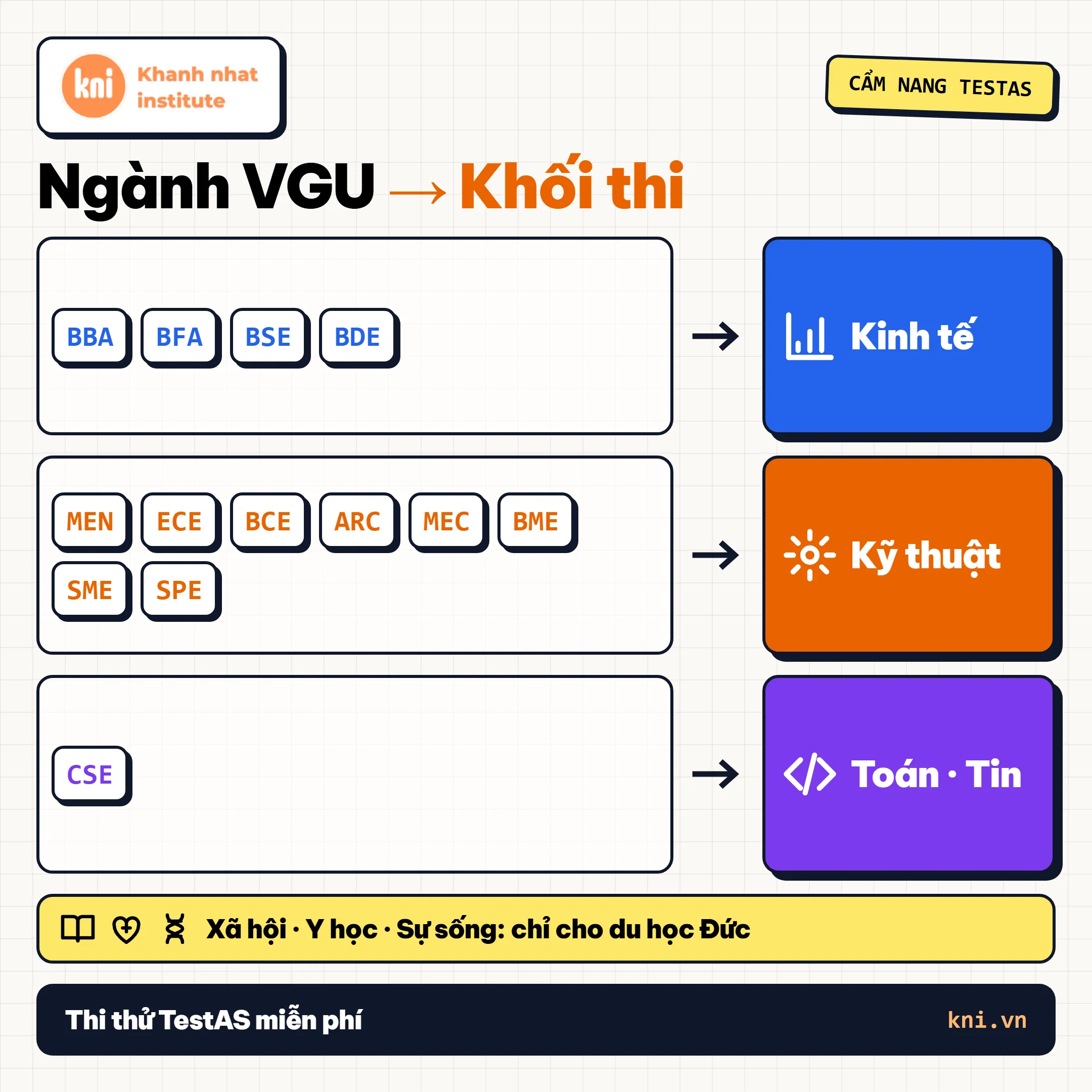
| Degree Program at VGU | Study Disciplines in Germany | Required TestAS Module |
|---|---|---|
| Business Administration (BBA)Finance & Accounting (BFA)Economics (BSE)Digital Business (BDE) | Economics (VWL), Business Administration (BWL), Marketing, Finance, Logistics | Economics |
| Mechanical Engineering (MEN)Electrical & Computer Eng (ECE)Civil Engineering (BCE)Architecture (ARC)Mechatronics (MEC)Biomedical Engineering (BME)Smart Mobility (SME) | Mechanical, Electrical, Automotive, Robotics, Civil, Aerospace, Architecture | Engineering |
| Computer Science (CSE) | Computer Science (Informatik), Mathematics, Data Science, Applied Physics | Mathematics, CS & Natural Sciences |
| (Not offered at VGU) | Law (Jura), Linguistics, Psychology, Sociology, Media & Journalism | Humanities & Social Sciences |
| (Not offered at VGU) | Human Medicine (Humanmedizin), Dentistry, Pharmacy | Medicine (Select Digital TestAS) |
| (Not offered at VGU) | Biotechnology, Molecular Biology, Environmental Sciences | Life Sciences (Select Digital TestAS) |
Review VGU admissions guidelines: How to Apply to Vietnamese-German University (VGU) with TestAS.
5. Three High-Scoring Preparation Tactics for Subject Modules
- Prioritize methodology over memorization: The Engineering exam never requires calculus derivations; the Economics test never quizzes arcane financial formulas. The test measures how you interpret analytical models. Practice with official sample tests from g.a.s.t. to acclimatize to item archetypes.
- Master academic field vocabulary early: Whether testing in English or German, unfamiliarity with basic mathematical and engineering syntax (proportional, inversely proportional, clockwise, flowchart, cross-section) squanders precious reading minutes. Compile a specialized glossary during your first study week.
- Simulate continuous testing under strict time limits: Subject modules span 90 minutes (digital) to 150 minutes (paper). Train with strict timers at home to build cognitive endurance and sustain peak concentration through the final question.
Read our comprehensive prep guide: TestAS Preparation Guide from A–Z: Roadmap and Time Allocation.
Conclusion
Choosing the correct TestAS subject module is the vital first step toward a compliant application dossier and maximizing admission odds at German universities and Vietnamese-German University (VGU). Cross-verify your prospective degree requirements carefully before registering on the international examination portal.
Master Your TestAS Module with KNI Education
If you need baseline diagnostic assessments, experience with countdown pressure on authentic simulation software, and a streamlined 6–8 week curriculum, train with KNI Education.
👉 Register for Free Diagnostic Testing and Personalized Advising at KNI to select the right module and achieve your target score!